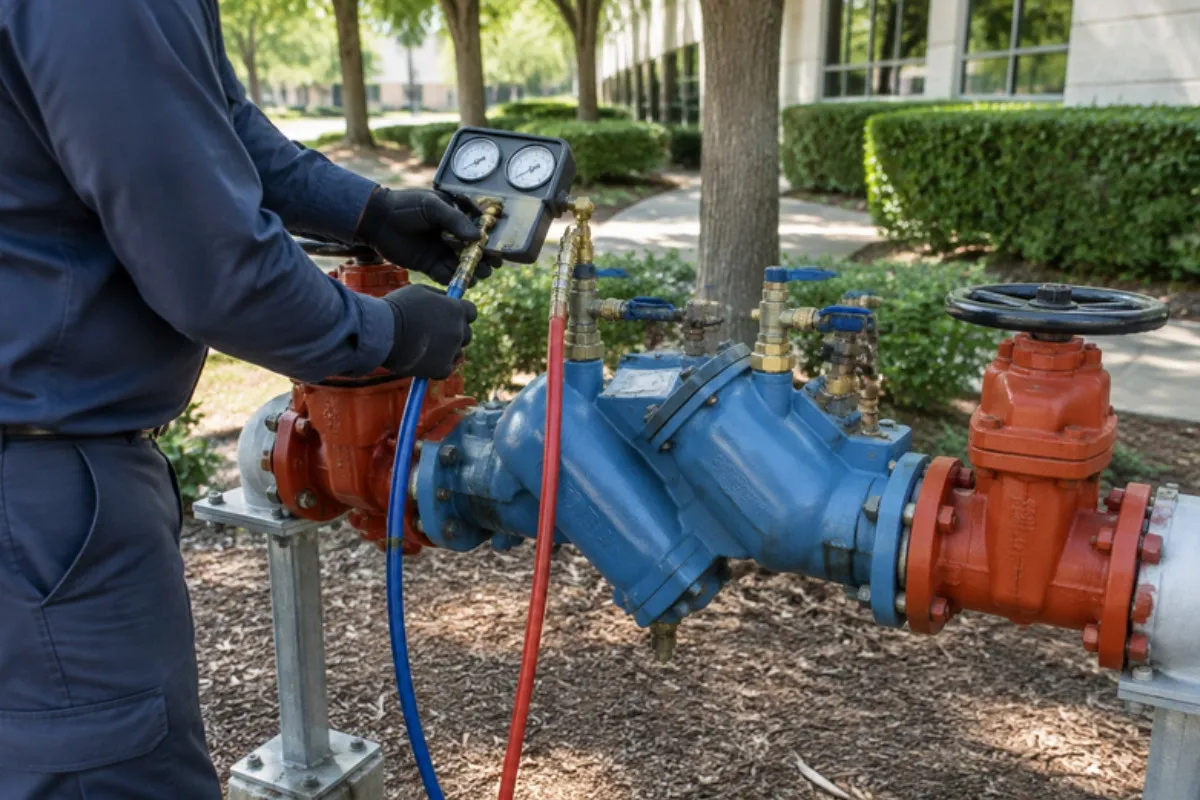
In Washington, DC, backflow prevention assemblies are installed at a building's water service connection and must be tested every year, with the test report sent to DC Water's cross-connection control office. Requirements come from the DC Plumbing Code or DC Water's Cross-Connection Manual. Call the number on this page to be connected with a local plumber in Washington, DC who tests and repairs backflow assemblies.
Why the District cares about backflow
Drinking water should only travel one direction, from DC Water's mains into a building. Backflow happens when it reverses: a main break or heavy fire-hydrant use can drop street pressure and pull water backward, and a boiler, pump or pressurized system inside a building can push it backward. Without protection, water from a fire sprinkler line, an irrigation system, a cooling tower or a commercial kitchen could reach the public supply. A backflow assembly blocks that reverse flow.
How the process works in DC
- Who oversees it: the cross-connection control office in DC Water's Drinking Water Division.
- What applies: backflow requirements come from the DC Plumbing Code or DC Water's Cross-Connection Manual.
- Where the device sits: at the building's water service connection.
- How often: every assembly is tested annually.
- Paperwork: the test report goes to the cross-connection control office.
Installing a new backflow preventer is plumbing work; the DC Department of Buildings plumbing permit application lists backflow preventers and is signed by a Master Plumber or Gas Fitter.
Typical assemblies
| Assembly | Where it is often used |
|---|---|
| Reduced pressure zone (RPZ) | High-hazard connections, many commercial and medical buildings |
| Double check valve assembly | Lower-hazard services and many fire sprinkler lines |
| Pressure vacuum breaker | Lawn and garden irrigation |
Failed tests and winter damage
When an assembly fails, the cause is often debris holding a check open, a tired spring, worn rubber parts or a relief valve that drips. In this climate, freezing is a real risk for any device installed outdoors or in an unheated vault or garage: a cold night can crack the body or bonnet. Insulated enclosures and draining irrigation devices before winter help. A tester can often rebuild the assembly with a parts kit and retest it on the same visit; a cracked body means replacement and a new test.
What drives the cost
Price depends on how many assemblies you have, their size and type, how easy they are to reach, whether repairs or parts are needed, and whether the device must be replaced. Buildings with several assemblies, such as a domestic line plus a fire line, often schedule all of them on one visit so the reports go in together.
Backflow Testing questions from Washington homeowners
How often does a backflow assembly need testing in DC?
Where do DC's backflow requirements come from?
Does a single-family home need backflow testing?
What happens if my assembly fails?
Related plumbing services in Washington
Helpful guides
Backflow Testing in nearby cities and towns
Arlington County
Alexandria City County
Fairfax County
Fairfax City County
Falls Church City County
Loudoun County
Prince William County
Manassas City County
Montgomery County
Prince George's County
Charles County
Sources
Last updated: