DC Water describes District tap water as moderately hard, usually about 3 to 9 grains per gallon depending on location and season, so a softener is optional rather than essential for most homes. It makes the most sense if you see steady scale on fixtures, run a tankless heater, or simply prefer softer water. Call the number on this page to be connected with a local plumber in Washington, DC who can install or repair a softener.
How hard is the water in the District?
DC Water buys treated Potomac River water from the Washington Aqueduct and delivers it across the city. In its water quality FAQs, DC Water calls that water moderately hard, typically around 70 to 120 ppm (3 to 9 grains per gallon), with the figure shifting by neighborhood and season. Its annual water quality report lists an average total hardness of 126 ppm, about 7 grains per gallon, with a range of 78 to 175 ppm.
That is a middle-of-the-road number. Some households never notice it. Others see chalky spots on glass, crust on aerators and showerheads, or sediment collecting in a tank water heater over the years.
Who tends to benefit
- Homes with a tankless water heater, where scale in the heat exchanger cuts efficiency.
- Owners tired of descaling fixtures and glass shower doors.
- Households that want softer-feeling water for bathing and laundry.
- Buildings with a lot of hot water use, such as larger rowhouses split into units.
Chloramine and filtration
DC water is disinfected with chloramine, a mix of chlorine and ammonia, with a short chlorine-only stretch each spring. A softener does not remove chloramine or change taste. If taste or odor is the complaint, ask about a carbon filter rated for chloramine, either whole-house or at the kitchen sink. Many owners pair the two: a softener for scale and a filter for drinking water.
Installation in older homes
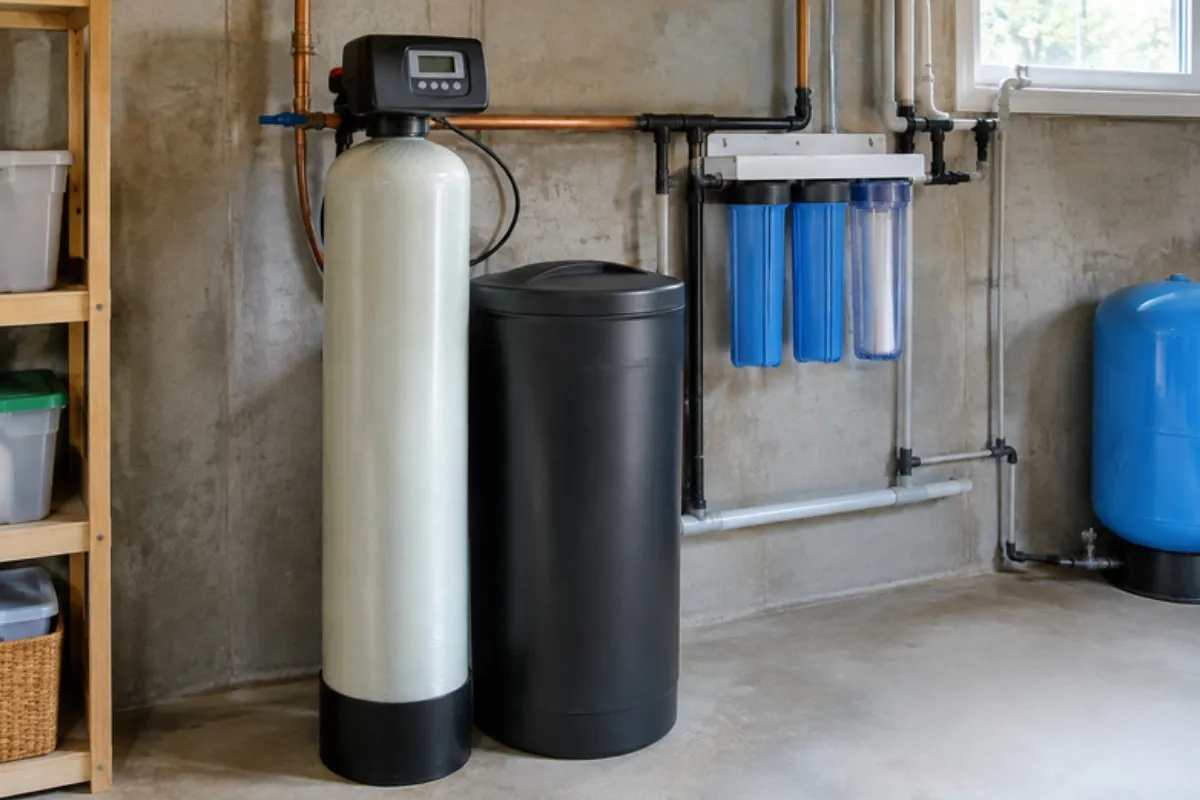
Few District rowhouses were built with a softener loop. The plumber usually cuts the unit into the main line just after the meter and main shutoff, often in a basement or utility closet, adds a bypass valve, runs a drain line for regeneration and finds an outlet for the control head. In tight basements, space and drain access drive most of the planning. If the work adds new fixtures or alters the water service, ask whether a plumbing permit from the DC Department of Buildings applies.
Common repair calls
- A crusted salt bridge in the brine tank that stops regeneration.
- A control valve stuck in a cycle or set to the wrong hardness.
- Leaks at the bypass or head O-rings.
- A drain line that freezes in an unheated space during a cold snap.
What affects the price
Cost depends on the size and type of unit, how much re-piping the main line needs, distance to a drain and outlet, whether filtration is added, and ongoing salt or cartridge costs.
Water Softener questions from Washington homeowners
Is Washington, DC water hard?
Will a softener remove chloramine?
Do I need a softener for a tankless water heater?
Where does a softener go in a rowhouse?
Related plumbing services in Washington
Helpful guides
Water Softeners & Filtration in nearby cities and towns
Arlington County
Alexandria City County
Fairfax County
Fairfax City County
Falls Church City County
Loudoun County
Prince William County
Manassas City County
Montgomery County
Prince George's County
Charles County
Sources
Last updated: