A hidden leak in a Germantown home usually shows up as a WSSC Water bill that climbs for no clear reason, a meter that keeps turning with every tap closed, or a stain spreading across a basement ceiling. A plumber tracks it down by testing one section of piping at a time instead of opening walls on a hunch. Call the number on this page to be connected with a local plumber in Germantown.
What happens when you call
The call is routed to an independent plumber who works in Germantown and the neighboring I-270 communities. Expect a few questions up front: how long the bill has been high, whether you have watched the meter with everything shut off, and whether you have seen moisture, heard a hiss inside a wall or noticed a strip of lawn that never dries out. Those answers tell the plumber whether to start indoors, at the water heater, along the irrigation system or on the buried line between the meter and the house.
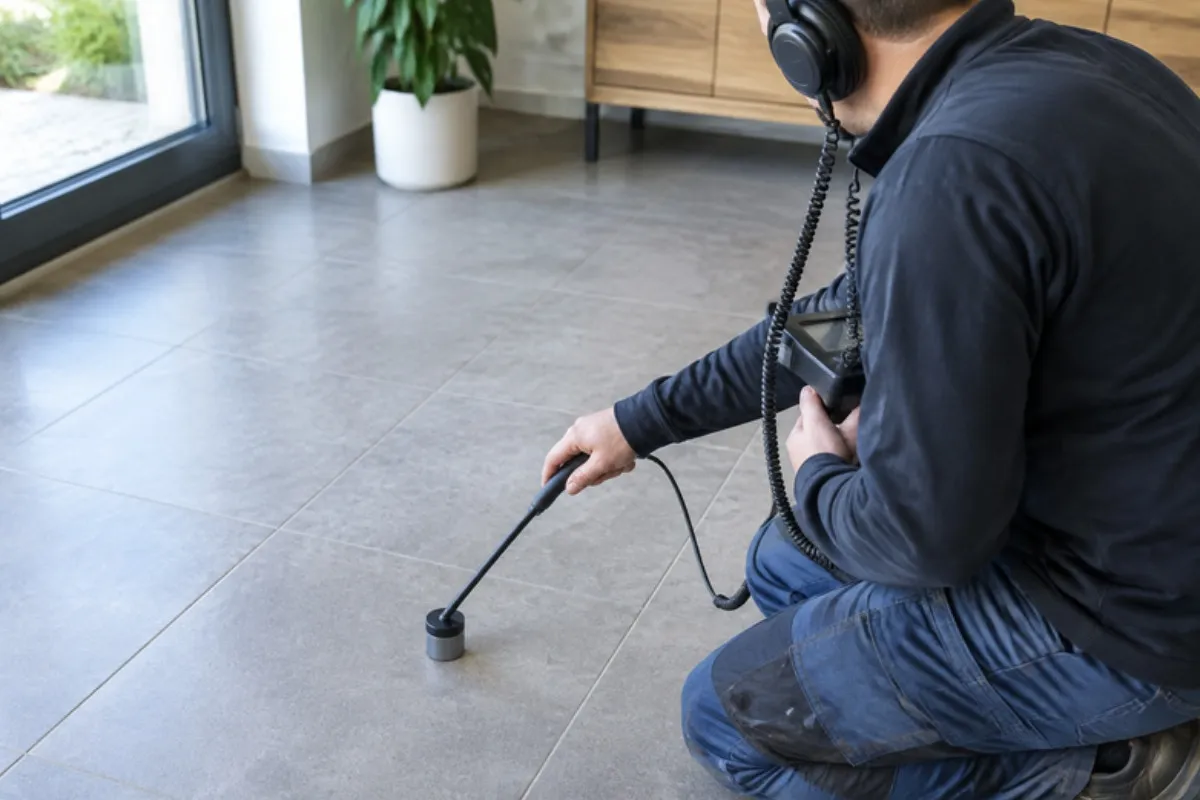
On site, the usual sequence is to confirm the loss at the meter, then close off fixtures and branches until the flow stops. Moisture meters, thermal imaging and acoustic listening gear narrow the spot down so any opening in drywall or flooring stays small.
What affects the cost
- How many isolation and pressure tests it takes to pin down the location
- Whether the water is escaping behind finished drywall, under a concrete floor or out in the yard
- Specialized equipment such as thermal cameras or ground microphones
- The repair that follows, from swapping a supply connector to replacing a run of buried service pipe
- Whether that repair needs a WSSC Water permit, as service line repairs do
Germantown conditions worth knowing
Germantown took off after a sewer line reached the area in 1974, and the biggest share of homes in the 20874 ZIP went up during the 1980s; fewer than one in five predate 1980. That puts a lot of original shutoff valves, toilet fill valves, supply connectors and water heater fittings at an age where slow seeping is common, even though the houses themselves are not old by regional standards.
Water comes from WSSC Water's Potomac and Patuxent plants. WSSC's tap analysis lists average hardness near 140 mg/L for Potomac plant water and about 64 mg/L for Patuxent plant water, so how much mineral crust builds on valve seats depends on which supply reaches your street.
Irrigated yards add another suspect. Testable backflow assemblies need a field test every year, and reduced-pressure assemblies have to be taken off and stored somewhere warm for winter. One left outside through a freeze can split and start leaking the day the system is turned back on.
Before the plumber arrives
- Find the main shutoff, usually where the line enters the basement or utility room, and check that it turns
- Note the meter reading, go an hour without using water, then read it again
- Drop food coloring into each toilet tank and look at the bowls after 15 minutes
- Keep recent bills handy to show when usage started rising
- If water is surfacing in the street or at the meter, call WSSC Water at 301-206-4002
Leak Detection questions in Germantown
Could the lawn irrigation system be where the water is going?
Does the local water make pipes more likely to leak?
Who do I call about water bubbling up near the meter or in the street?
Can a fairly new house have a hidden leak?
More plumbing services in Germantown
Leak Detection nearby
Sources
Last updated: