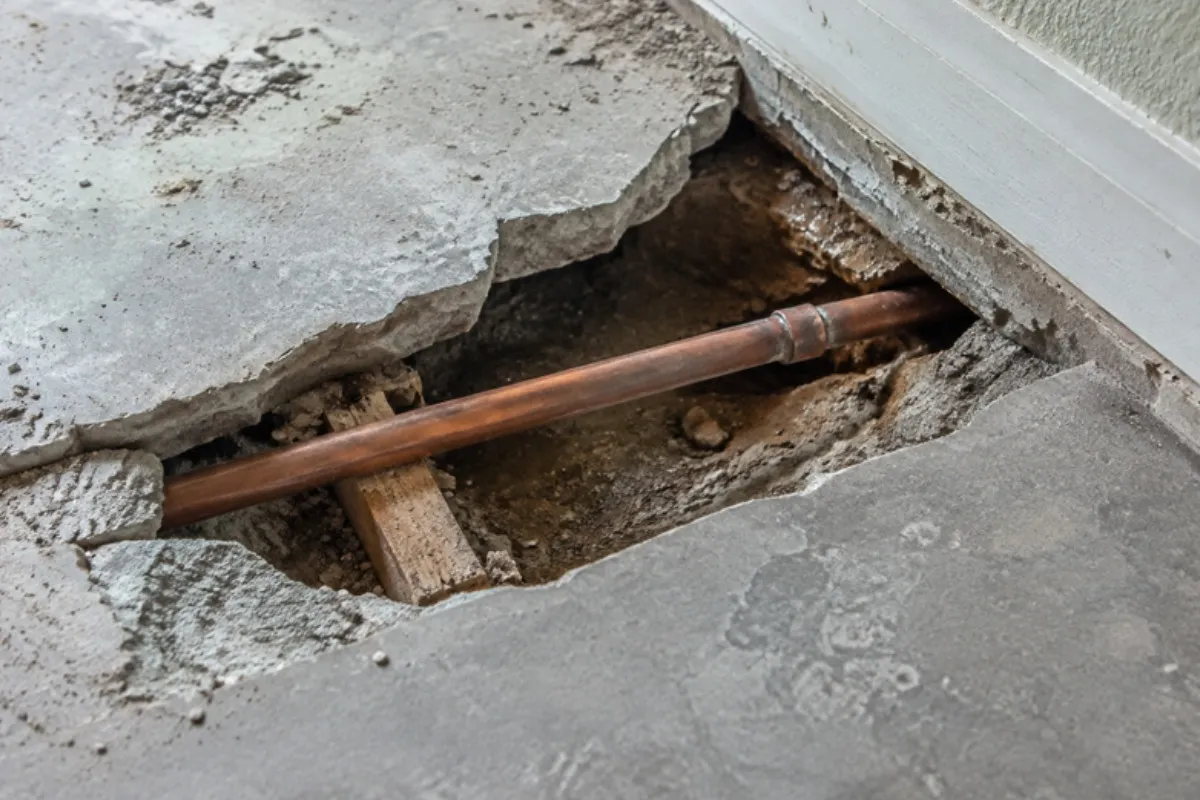
A slab leak in Capitol Heights is a water pipe leaking beneath a concrete floor, usually a basement slab or a slab-built lower level. Although the town borders the District, it is in Prince George's County and on WSSC Water, not DC Water, and the pipe under your floor is the owner's to repair. Call the number on this page to be connected with a local plumber in Capitol Heights.
Signs to check
- The meter's leak indicator moves while no water is used
- A basement or lower-level floor stays damp in one spot
- Warmth underfoot on a tiled or concrete floor
- Water pressure has dropped over time
- Mold or a musty smell in a finished lower level
Check exposed pipe, toilets and the water heater before assuming the leak is buried.
Capitol Heights homes
Capitol Heights began as a 1904 subdivision just past the District's eastern edge, where Northeast and Southeast Washington meet, and the Capitol Heights mailing name also covers nearby unincorporated areas. The median home here dates to about 1967. Houses from that era often still have original supply pipe, and older ones may have galvanized steel. Where that pipe runs under a basement floor to reach the shutoff, laundry or water heater, corrosion and settling can open a leak that goes unseen.
Because the town touches the DC line, it is easy to call the wrong utility. WSSC Water, not DC Water, serves Capitol Heights, and WSSC rules apply. WSSC owns the service line from the main to the property line, and the homeowner owns the rest. If water is surfacing near the street, call WSSC's emergency line, 301-206-4002. Right at the DC line, confirm by address on your bill.
What changes the cost
- Locating. A hot-side leak is often quicker to pin down than a cold one.
- Repair method. A small concrete cut and spot repair, or new pipe rerouted along the basement ceiling.
- Pipe age. Galvanized lines in poor shape may call for replacing the run rather than one section.
- Finishes. Tile, wood and finished basements add restoration time.
- Permits. WSSC Water issues plumbing permits; for the building side, Prince George's County publishes which permits the town or the county handles.
When you call
You will be connected with an independent plumber who works in Capitol Heights. Have your meter test result ready, describe where you saw damp or warm floor, and mention the age of the house if you know it. If water is pooling, close the main valve, usually on the basement wall where the service pipe enters.
Slab Leak Repair questions in Capitol Heights
Should I call the water utility or a plumber first?
Are older pipe materials more likely to leak under a floor?
How do I use the water meter to check for a hidden leak?
Can a drain pipe under the slab leak, not just a water line?
More plumbing services in Capitol Heights
Slab Leak Repair nearby
Helpful guides
Sources
Last updated: